Zak George's Guide to a Well-Behaved Dog
Zak George’s Guide to a Well-Behaved Dog: Proven Solutions to the Most Common Training Problems for All Ages, Breeds, and Mixes by Zak George and Dina Roth Port
★★★☆☆
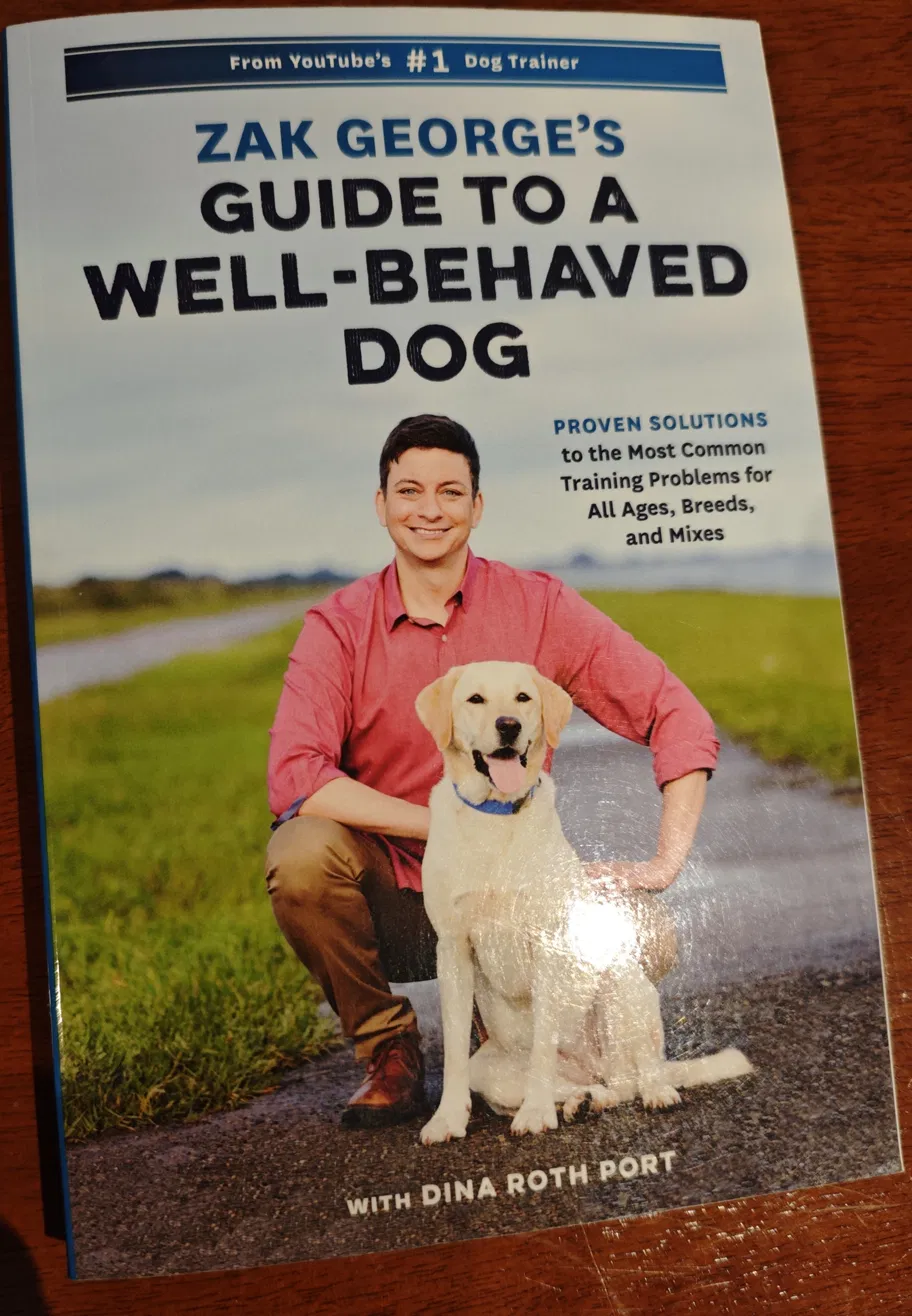
So this was supposed to be Part One of a two book review series, and you the reader will see both reviews posted at the same time. I promised myself I wouldn’t begin reading the second book before finishing the review of this book. And I haven’t. I did read two unrelated books in the meantime, but THAT’S NOT THE POINT. What’s the theme?
Put simply, #1 (this book) is about “Positive Reinforcement” dog training. You set up an environment for the dog to do things you like. The dog does the thing and gets rewarded. The dog learns to do the thing consistently. #2 is about “Balanced” dog training. You still reward the dog for things you like, but you also punish / “correct” it when it does things you don’t like.
+R trainers think Balanced trainers are unethical; they damage the dog-human bond; they encourage learned helplessness; they don’t work at all, and/or they’re not the most effective way and/or they’re dangerous when used incorrectly.
Balanced trainers think +R trainers are naive; that their methodology only works on eager-to-please dogs without serious behavioral problems; that it takes longer; that many dogs BE’d (killed for being difficult) could have been rehabilitated with balanced training.
It’s safe to say that training philosophy is one of the most controversial topics in the dog world, along with “rescue or breeder?” and “are doodles the worst thing ever?”
The second review will contain actual comparisons, because as it stands, I have zero idea what it’s about.
I was expecting to rate this slightly lower. I was hoping to find a parrot training book at my local Indigo (wishful thinking, I know) but this was the only animal training book they had, period. As such it’s aimed towards a very mainstream audience, and I wasn’t expecting to learn much new information. Also, I was trying to read it through the lens of a parrot owner. The efficacy was… variable.
The good stuff
Zak has a bunch of free Youtube videos.
Exercise, exercise, EXERCISE. He cannot emphasize this enough. If you have a difficult dog, it probably needs training, but it definitely needs EXERCISE. (sadly not applicable to parrots, and no, foraging doesn’t count)
A great thing about +R training is that it’s not dangerous if applied poorly. Zak tells you to go the vet to rule out medical concerns, or to hire professional help for severe aggression cases. Worst case: You’re a crappy trainer and your dog doesn’t learn anything. Or, more likely: your dog only listens to you when you have food in hand. That’s still a huge upgrade from a dog that never listens at all.
P. 187
Your results will only be as good as the training
I agree with this quote very much. I’m interested in training animals, but half of it is training the people. I don’t have (nor do I wish to develop) the skills to effectively tell someone: it is not the dog’s fault; it is yours. I don’t want to deal with the resulting defensiveness/hostility/etc.
And a preemptive defense to all my criticism: was he not formative? Zak George, Victoria Stillwell, Kikopup & co. are responsible for the dominance (pun intended) of +R training in online discourse, in current decade. For popularizing it for the masses, including teenage me! People take it for granted, but maybe it shouldn’t be. He did good for this world.
P. 10 Energy levels He splits dogs into three energy levels, low medium high. Low energy dogs are naturally well-behaved, easy, and not that motivated (my bird would fit into this category). High energy dogs have the highest training potential, but their exercise needs mean they’re not suitable for most casual owners. I wish he had discussed biddability at all- a husky is high energy, for example, but it’s not particularly motivated to please you.
Zak would take issue with that statement. He is pretty adamant that breed doesn’t matter, that it’s the least important factor. Coincidentally his three dogs were all border collies, the number one most trainable breed. He acknowledges that genetics do matter… but breed doesn’t… but breed is basically a bundle of similar genetics…
P. 155
It’s equally important to address what doesn’t cause aggressive behavior: breed!
This is such a weak argument. So you’re saying, if I were to selectively breed dogs that are good at fighting other dogs, do that for a few generations, make that an official dog breed… Would the resulting dog breed not be dog-aggressive?
Can I acknowledge that individual variation is huge; that learning history matters enormously; that my bird might be easier than a particularly cantankerous cockatiel? Yes! But his argument attracts much criticism, and for good reason.
Why do dogs hump?
it most often seems to occur when a dog is feeling playful or excited.
Yeah, I can think of at least one other reason.
babies in volcanoes point.
This is one of my gripes: Let’s say Team Volcano wants to sacrifice babies to the volcano goddess and Team Boring says nooo, don’t do that, it’s not nice. I kinda hate how Team Volcano is always the more tolerant side. They understand Team Boring better than vice versa. They might compromise. 50% reduction in volcano babies? Fine. But team Boring is like, noooo, ban ALL baby sacrifices. No ethical baby sacrificing under capitalism. Persecute baby sacrificers. Always enforcing their dang “morals” on my good volcanofolk.
But maybe that’s just because I believe people should be able to do whatever they want. I support a woman’s right to choose [to sacrifice her born children to Pele]. Apply this to dog training or any contentious topic you wish. Also, I hate the paradox of tolerance.
Parrot comparison stuff
P. 158
If you know that your dog is very uneasy around people who don’t follow basic etiquette when engaging a dog […] you can center your training efforts around these situations.
My bird (and nearly all companion parrots) would not tolerate a rude stranger. I don’t view this as a problem; it is my job to set up the environment so that neither he nor the stranger is at risk. If he ever bites such a stranger, it is my fault because I was not there to protect him, so that he felt like he had to escalate.
[capturing a specific behavior] takes dozens of repetitions over time, but dogs do catch on to what these requests mean when introduced contextually.
Reason #one million of why parrots are better than dogs. I do not have to wait “dozens of repetitions.” I capture it once, he knows what’s up, and then he continues not doing it, because my approval is irrelevant and that naughty thing is more fun than getting one singular pignon.
The importance of surprise training sessions. Sometimes it’s about what happens in the moment. And also implementing intentional surprises, like dropping a steak on the floor while training “leave it!”
This is applicable to parrots, and the single most relevant takeaway for me. I already do this, but I’d like to make it a more conscious decision. Intentionally make a distraction go off in the background, reward him for staying focused.
To conclude, this is my own boring cop-out take: I am a sheeple, and +R-only parrot training is far more common (relatively speaking) than +R dog training, and as such I have absorbed it through osmosis.
Okay, well there is that thing where you push your finger into the bird’s chest and it’s forced to step up, and you just tank the bite. Have fun doing that with a macaw.
I enjoy my streak of being bitten zero (0) times in the big 2026 by ol’ Aggressive and Unreliable and I wish to continue it indefinitely, although I know that is highly improbable.
If I need to punish my way into controlling my 20 pound super-biddable-but-also-chill doodle and my two pound bird, I am a loser. I do not identify as a loser, therefore I must not be lowered into the depths of balanced training.
For now.