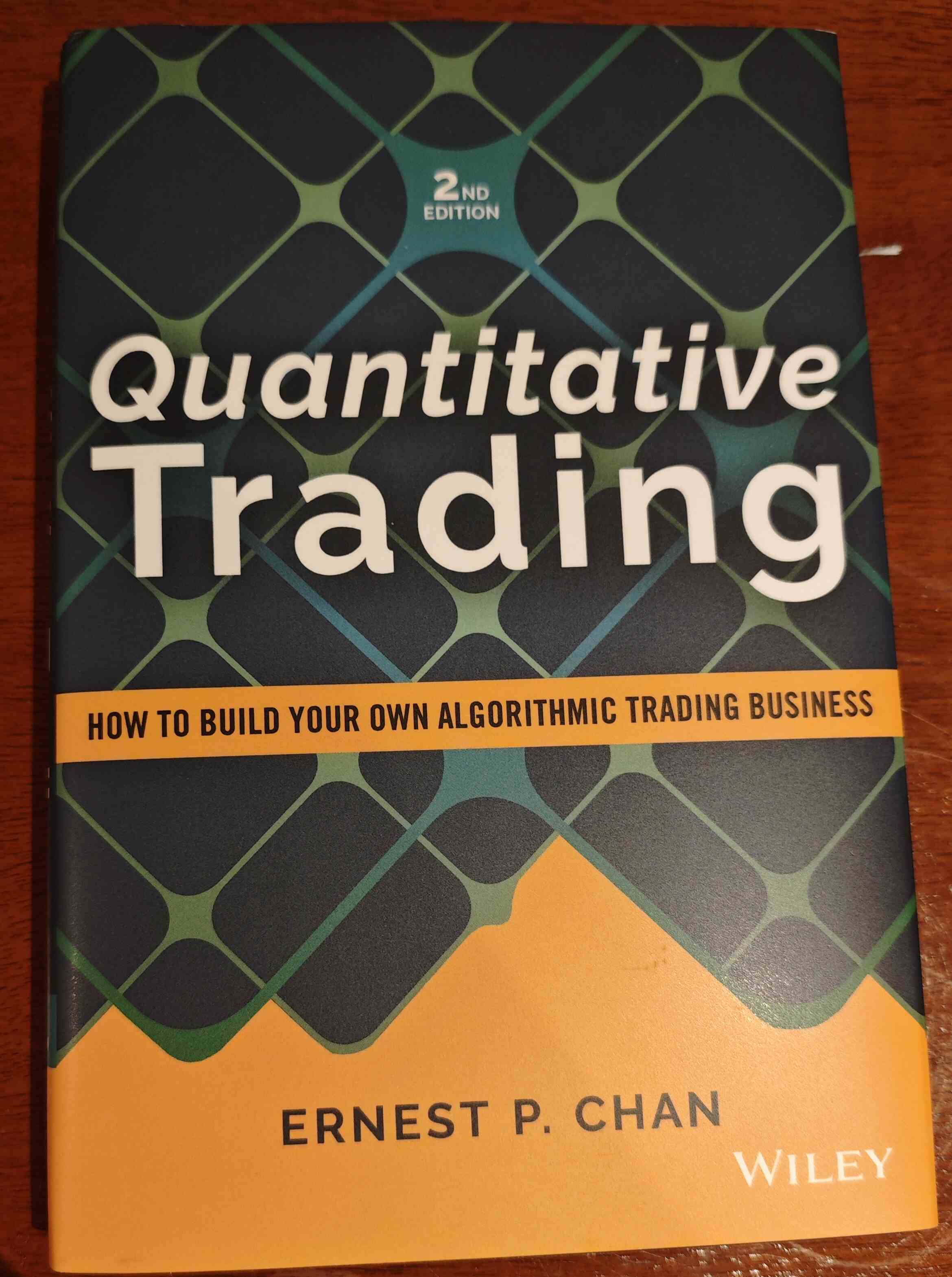
Quantitative Trading
Quantitative Trading: How to build your own algorithmic trading business by Ernest P. Chan
Rating: ★★★★☆
So I find the idea of quantitative trading pretty romantic, and I’m surely not the only one.
Meritocracy! Antisocial! Morally questionable! Exceptionally high pay, to the point where you can buy basically whatever you want! High risk/high reward, constantly shifting, and oh-so-mysteeeeeerious.
You get it.
What I liked:
- It assumes competence. Like, of course you know how to code. If you don’t, fix that and come back later. It gets one sentence. And of course you’ll need some college-level math concepts. If you don’t - begone. I enjoy feeling like the dumbest person in the room, but for books.
- The variety of topics. You’ll see the standard stuff, along with topics like emotional management (find a hobby, skill issue), behavioral finance, the benefits of MATLAB over Python, and how to keep the evil programmers from stealing your secrets (get multiple, or NDA it, or suck it up)
- The sources! There’s a list of references at the end of every chapter, right after the chapter summary. Ernest often cites himself. Go get ’em, king.
- I’m pretty sure he makes an effort to end sentences at the end of a page. Small thing, but pretty cool once you notice it.
How much is $100,000? An entry-level luxury car. A fraction of some student loans. About three Hyacinth macaws. And, apparently, the minimum recommended starting investment if you want to find success being an independent quant. Is it a big number? I suppose that’s for you to decide.
I find the morality aspect fascinating, far more so than the morality of keeping parrots in captivity. You can say that something is worth as much as one is willing to pay. It’s not about how much value it provides to society. But what about those little mistakes that cause enormous real-world consequences? Can someone write a whole book about that? I’d totally read it.
One of the ending chapters briefly touched upon one benefit of independent trading: alignment of motivations. If you work at RenTech or something, you have everything to gain and only your job to lose. Why not take the highest-risk, highest-reward strategies you can get away with? But with your own money, you can lose a lot more. You operate with your best interests in mind. Bake that thought yourself.
What I didn’t like:
- Ernest does a fair bit of self-promo for his predictnow.ai site.
- There’s a lot of code snippets. I think I’d have gotten more value if I’d actually tried running some of them. Does it really need the same snippet in MATLAB, then Python, then R? And maybe I prefer looking at code snippets on a computer screen, not a page.
- I didn’t understand some parts, and it was somewhat boring. But this is 100% on me, not the writing. There are some topics that nobody can make interesting. There’s a book on my to-read list about the history of Californian cheeses…
Take some yummy quotes to finish this review off.
This is because, as I pointed out previously, the application of the Kelly formula to continuous finance is premised on the assumption that return distribution is Gaussian.
Um, yes, of course. This is like Artemis Blu, except I’m pretty sure I’m supposed to understand these words.
The truly scary scenario in risk management is the one that has not occurred in history before.