The Art of War
★★☆☆☆
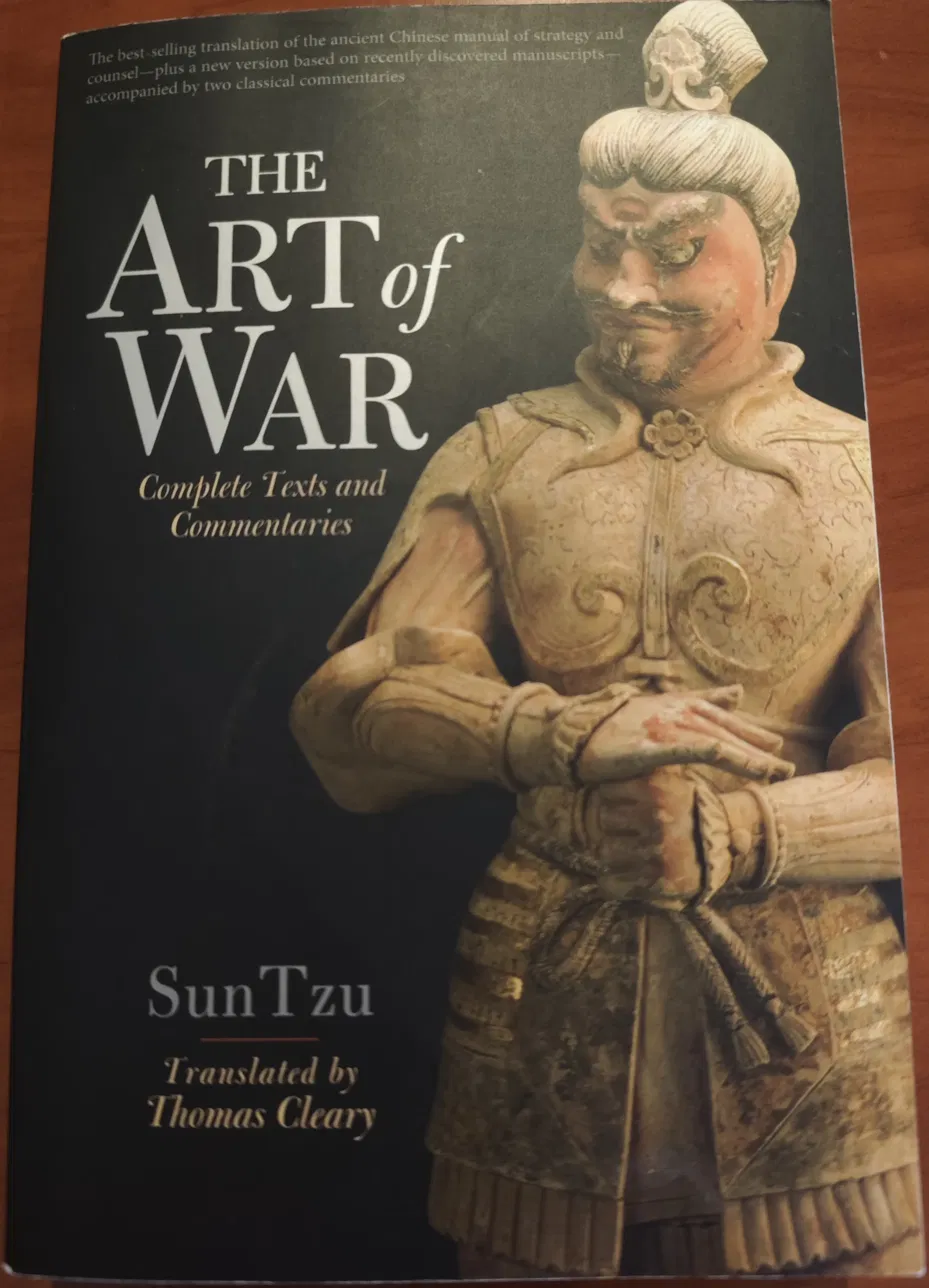
The Art of War: Complete Texts and Commentaries by Sun Tzu, Translated by Thomas Cleary
I suffered considerably while reading this 457 page book. Perhaps you’ll enjoy it more than I did.
The introduction alone was forty pages. Well, no. The introduction of the first book.
You can understand, then, that I was eager for the teachings of Sun Tzu Himself, and not Boring Old Translator Thomas.
Nooo. I was soon wishing for more of the distinguished hexalingual scholar Mr. Thomas Cleary. Actually, he might know more than six. The text on the back cover implies at least six.
Totally Not exaggerated for comedic effect
Sun Tzu: One should avoid conflict when possible.
Matt: Master Sun here is saying that when possible, one should avoid conflict.
Pat: I believe the word ‘avoid’ refers to not doing.
Rat: ‘Conflict’ is a figure of speech. Master Sun believes that War is a divine good which should be mongered whenever possible. As long as the victory is decisive, conflict is excellence.¹
Yacht: I agree with Rat.
Kumquat: I was climbing a mountain once, in my youth. Quite a magnificent mountain it was. A parrot (I entertain a profound and unshakeable postulation that the specimen was none other than Psittacus erithacus, and a particularly fine one at that) spoke to me in a dream. It said, “One should avoid conflict when possible.” Just as I followed the path up the magnificent mountain, I followed the words of the wise and unknowable psittaciforme, which I now believe to be the spirit of Master Sun himself. I avoided conflict when possible; when possible I avoided conflict, and thusly did I lead a rich and meaningful life full of moderation and contentment, not excess, because I am a humble student in the teachings of the Yellow Emperor Huang Di and the ancient peach Tao.
Sun Two: On my military campaign the other day, I had an opportunity to partake in conflict. I chose to avoid it, as it was possible. This led to saving the lives of all my soldiers (which I view as my children and do not spoil, because you should not spoil your children). My soldiers would die for me, by the way. Happily.
Hat: ‘One’ refers to a party, or people in general, or the numeric unit of the first and lowest number that is not the absence of one. I am not quite sure.
Eat: ‘One’ refers to people in general.
Yacht: I agree with Eat.
Now, repeat this for every single line in the Art of War. It’s not a long book, except now it is.
But that’s not all. This book’s actually four in one. So after you finish the thirty-nine pages of introduction, then 137 pages of The Art of War (complete with commentary from Pat, Rat, Kumquat & co), THERE’S MORE!!! There’s Mastering the Art of War, which honestly I don’t remember one bit.
Then there’s The Lost Art of War, written by Sun Tzu’s descendant Sun Two Sun Bin, sorry. Mr. Bin takes a more verbose and literal approach. OG Sun Tzu’s all metaphors that are, to varying degrees, applicable to modern life and conflict in general. Bin’s more about literal military tactics. It’s the most repetitive book. Format: 1) You should do so-and-so. 2) Once, someone did so-and-so on their campaign/attack/defense. 3) They won. The enemy was defeated/scared away/goaded to peace/other victorious outcome.
Last and perhaps least is The Silver Sparrow Art of War. My favorite part, no joke, was what wasn’t there.
Page 377:
There are significant lacunae in every sentence of this chapter, such as to make it impractical to attempt to produce an accurate and meaningful translation.
Page 384:
[Title Lost] This chapter is so fragmentary that even the order of the strips is uncertain.
I feel, I dunno, a little connected to history when I’m reading those clean white pages and he just says they’re not available. Erased by time. It feels realer somehow.
These were the most interesting takeaways.
- Use your people to their strengths. You can send a greedy person to go get money, you can send a foolish person to go die, etc. Page 83.
- If your only choices are winning or dying, then you will fight as hard as you can. So it can be good to enter such a position, like deep within enemy ground with no escape.
- The idea that winning and losing wars are both bad outcomes. Obviously if you keep losing, you will be weakened. But if you keep winning, you will get haughty.
- Spies are good. Great, even! In fact, you’re unethical for not using spies, because you can prevent a lot of suffering and end conflict sooner. Pay them a fair wage.
- But you can’t pretend to ally with the enemy, no no. Enemy-of-your-enemy, sure.
- But misleading them is fine. But not your own people, because you must be Trustworthy.
CONCLUSION
Page 407, emphasis added.
An academic attempt to translate the newly discovered Art of War has been made, unfortunately without success, being based on the erroneous belief that the Chinese world view lacks intelligibility and predictability. […] In any case, having found that academic work of no value in this connection, […] I draw on my own original unpublished translation
I LOVE this shade. Ancient China needs defenders like you, Thomas Cleary 🙏
Page 35:
In twenty years of translating, never have I seen or translated an Oriental classic that I did not find so rich as to be able to generate at least three possible translations.
Overall I disliked the book because it was repetitive and often contradictory: You should do X, except sometimes you don’t do X, because you gotta be mysterious! When you are X, you are not Y; when you are Y, you are not X. Many word to say few thing. On the other hand, it is undeniably a classic and Thomas Cleary was goated for translating it all.
¹ Real example: Page 122 Sun Tzu: Unless you use local guides, you cannot get the advantages of the land. Mei Yaochen: You can use local guides, but I think having professional scouts from elsewhere is better.